Learning to Live with Our Ghosts: Ayyappa, Yoga, and the Art of Becoming
There is a question I return to again and again in my yoga practice and teaching: Given what has made me, who do I want to become?
It's a question that asks us to consider our histories, our circumstances, our choices, and our possibilities. It invites us to acknowledge all that has shaped us without surrendering our capacity to shape what comes next.
Recently, I shared a story in my Sunday morning yoga class (link to youtube) about Ayyappa, the extraordinary son of Shiva and Vishnu. I learned this particular telling from my teacher, Douglas Brooks, through his teachings in the Rajanaka tradition of Śrīvidyā Tantra.
Like many stories from Hindu mythology, Ayyappa's story has been told and retold across generations, regions, and traditions, with variations in its characters and details. What follows is the telling I learned, along with some of the philosophical insights and questions it has inspired in my own practice and teaching.
It's a story about gods and demons, grief and revenge, and the divine nature that persists even beneath our most frightening forms. And like so many of the great stories of yoga, it is also a story about us.
The Story of Ayyappa and Mahishi
Once upon a time, a powerful buffalo demon named Mahishasura was wreaking havoc in heaven and on earth.
Protected by a boon that no god, man, or animal could defeat him, he believed himself invincible. But he had underestimated the power of the Goddess.
After a great battle, Durga defeated Mahishasura and restored harmony to the universe. This is one of the great stories celebrated during Navratri, the nine nights honoring the Goddess.
But the story did not end there.
Mahishasura had a sister named Mahishi. Devastated by her brother's death, she sought revenge. Through intense spiritual practice, she obtained a boon of her own: only a child born of Shiva and Vishnu could defeat her. She believed no such a child could ever exist. And so, believing herself invincible, she began terrorizing heaven and earth.
Her suffering became suffering for everyone around her.
Vishnu, the great God and sustainer of the universe, incarnates in many different forms, including Rama and Krishna. Once upon a time, he takes the enchanting feminine form of Mohini. From the union of Shiva and Vishnu as Mohini, Ayyappa is born.
Ayyappa is a secret child, born of a forbidden union between two of the greatest divine powers: Shiva, Parvati's husband, and Vishnu, whom some traditions regard as Parvati's brother. His very existence defies what was thought possible. In the telling I learned, his birth is also marked by secrecy, betrayal, rejection, and abandonment. And yet, this child of such extraordinary and complicated circumstances will rise to meet the possibility of his own greatness.
Eventually, Ayyappa and Mahishi meet in battle. Ayyappa defeats her, destroying her demonic form and releasing her from the curse that has consumed her. And from that fallen form emerges Leela, radiant and liberated, restored to her divine nature.
Consider that moment.
Beneath the terrifying form, beneath the rage, the grief, and the destruction, there was something more. Her suffering, and the suffering she caused, were not the whole truth of who she was.
The divine had been there all along.
The Demons We Live With
I find this story especially compelling because it asks us to consider how suffering can transform us, and not always for the better. Grief can become anger. Fear can become control. An unmet need can become a demand that nothing ever seems to satisfy. Sometimes we become so identified with our defenses that we forget there is anything underneath them.
And sometimes, like Mahishi, our suffering becomes suffering for the people around us. This doesn't excuse harmful behavior. Quite the opposite. It asks us to recognize suffering clearly enough to respond to it with both compassion and discernment.
What am I protecting? What hurts? What needs care? And what behavior needs a boundary? We can honor anger without allowing it to govern our actions. We can make room for grief without asking ourselves to be finished with it. We can acknowledge fear and still make a choice about what comes next. We can extend compassion without abandoning accountability.
The work is not to deny our difficult parts, nor to allow them to rule our lives. It is to recognize them, tend to them, and discover what else might be possible.
We Must Learn to Live with Our Ghosts
Ayyappa is also known as Bhutanatha, the Lord of Beings, including the spirits and ghosts.
In the teachings I've learned from Douglas Brooks, these ghosts invite us to consider the traces of our histories: what happened to us, what we have done, what we have inherited, and what remains unfinished. Our ghosts are our memories, our patterns, our regrets, our longings, our losses. They are the experiences that continue to live within us, sometimes long after the events themselves have passed.
And we all have them.
We must learn to live with our ghosts.
Not deny them. Not pretend they aren't there. Not surrender to them. But recognize them as part of the complicated and particular lives we have lived. This brings us to an important distinction in the philosophical teachings I've studied, between particularization and individuation.
We are each the outcome of a process of particularization. We were born into particular families, cultures, circumstances, bodies, and moments in history. We inherited relationships, opportunities, limitations, and experiences that shaped us long before we could consciously choose for ourselves.
You had your mother. I had mine. You had your childhood, your relationships, your particular triumphs and traumas. I had mine. We are each a unique expression of countless influences. And these influences continue to shape us physically, mentally, emotionally, and constitutionally.
The task of yoga is not to deny these particulars, reject them, or transcend them. It is to receive them, acknowledge them, and work with them.
This is where individuation begins.
Through practice, we learn to examine the conditions that have shaped us. We begin to see how our histories live within us, how our patterns influence our behavior, and how our choices participate in the ongoing process of becoming.
We are continually being made and remade by our experiences, our relationships, our actions, and their consequences. But we need not be merely victims or passive participants in that process.
Yoga teaches us that we have choices. Not unlimited choices, but real choices.
The idea that we can make ourselves into absolutely anything is a fantasy. We cannot erase our histories, transcend every limitation, or simply will the world into becoming what we wish it to be. But we can work with what we've been given.
Yoga is the pursuit of the possible.
What Happens When the World Doesn't Change?
There is something else about Ayyappa's story that feels especially relevant to the world we are living in. We may want our practice to change the world. It won’t. We may want our efforts, our activism, our kindness, and our good intentions to produce the outcomes we hope for. And sometimes they do; and sometimes they don't.
The world we live in remains turbulent, unjust, frightening, and profoundly disappointing. Sometimes we do everything we can, and still experience loss. Sometimes we confront one demon only to discover another. The demons of the world cannot simply be eradicated. And in confronting them, we must be careful not to become demons ourselves. This is not an argument for resignation. It is an invitation to something more demanding.
Who do we want to be when the world does not change as we wish?
What kind of life do we want to create? What kind of choices do we want to make? What kind of example do we want to offer?
These questions don't ask us to give up on changing the world. They ask us not to make our humanity dependent upon the world changing first.
We can continue to care, to act, to resist injustice, to create beauty, to build relationships, and to work toward something better, even when the outcome remains uncertain.
Ayyappa's story reminds us that even in the most difficult circumstances, there is still a future to participate in. And the question is not simply what will happen next. It is who we intend to be as we meet it.
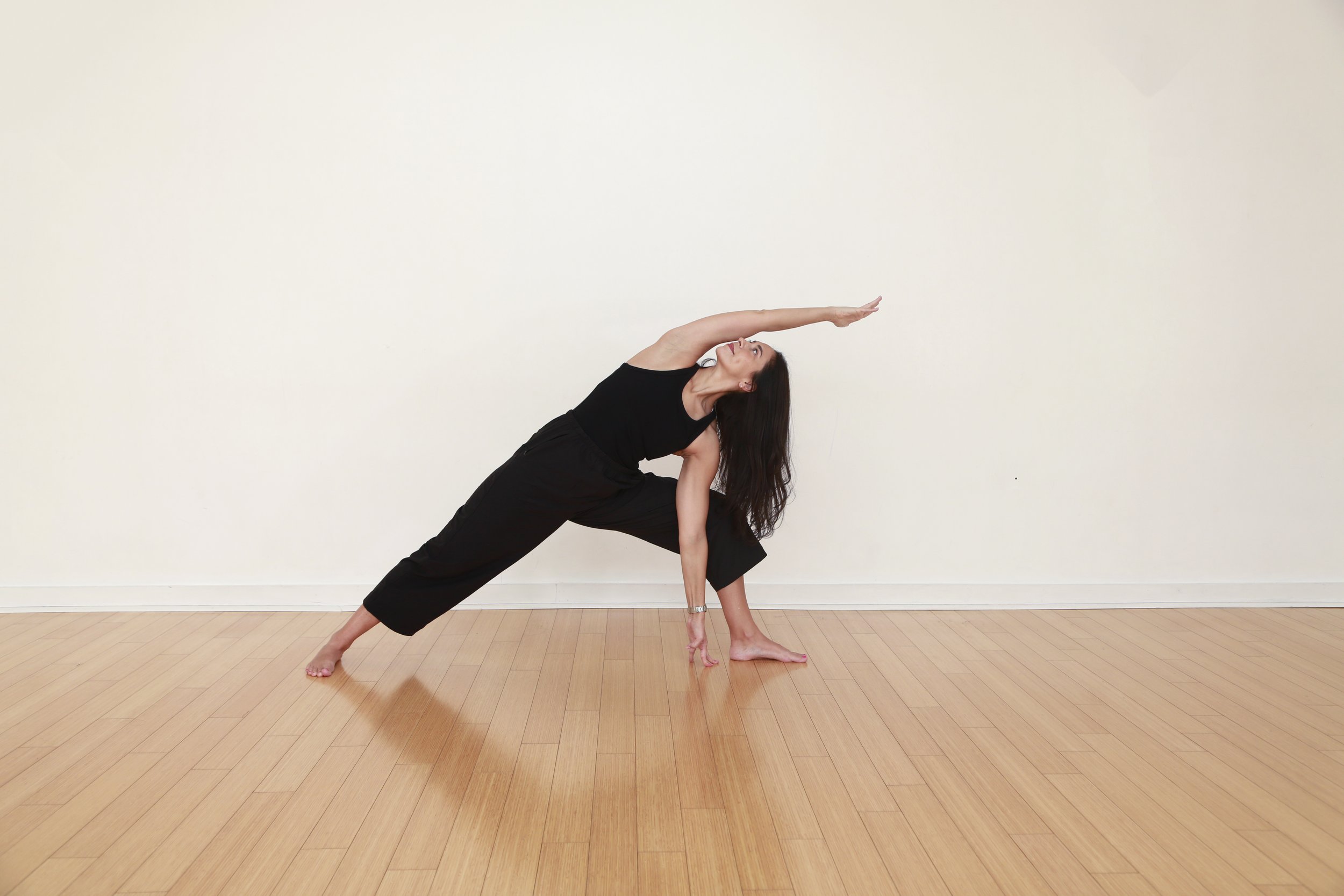
We are each the outcome of countless influences: our histories, relationships, successes, traumas, and circumstances. Yoga does not ask us to erase what has made us, nor does it require us to eliminate that which haunts us. It invites us to receive, embrace, and adore who we are; to acknowledge and affirm who we were; and to participate more fully in who we are becoming.
Practicing the Art of Becoming
This is where these teachings come alive for me on the yoga mat.
The world is turbulent, messy, uncertain, and confusing. And sometimes, so are we. Add the weight of our own histories, fears, and grief, and we may struggle to see clearly or know how to respond.
Yoga invites us to tilt, turn, and shift our perspective, to expand our awareness, and to see ourselves and each other more deeply, fully, and clearly. We experience instability to discover that stability is not the absence of instability. We twist and turn the body to untwist and focus the mind. We move through challenging transitions and change directions, learning to stay grounded and centered even in the midst of disorientation, uncertainty, and confusion—which, after all, are part of the ordinary conditions of being human, in and of the world.
Yoga does not remove us from life's complications. It teaches us how to participate in life more consciously, skillfully, and wholeheartedly.
In a recent class, we moved through Tree Pose, standing pigeon, Eagle, Warrior III, twisted Half Moon, revolved Sugarcane, and Crescent Lunge. Each shape offered an opportunity to explore:
Can I remain rooted while allowing myself to sway? Can I make space for discomfort, confusion, and uncertainty? Can I soften without sacrificing my strength? Can I change direction without abandoning myself?
And when I wobble, can I meet that moment with enough kindness and clarity to choose what comes next?
This is the beauty of embodied practice. We don't simply contemplate these questions. We experience them.
When things become challenging, notice your response. Do you push harder, hold your breath, criticize yourself, or want to give up? Can you pause, acknowledge what's happening, and offer yourself a steadier breath, an appropriate adjustment, or a little compassion?
I see this. I can give it my attention.
We practice staying present with ourselves, recognizing our patterns, and choosing how to respond. And perhaps discovering that who we have been does not define the limits of who we might become.
Who Do You Want to Become?
Ayyappa himself is born of unlikely and complicated circumstances. His origins are extraordinary, unconventional, and, in some tellings, secret and hidden. Yet he rises to meet the possibility of his own greatness. Mahishi, too, is more than her history of grief and revenge. The emergence of Leela reveals that beneath the demonic form was a divine nature that had never been entirely lost.
Neither story asks us to pretend the past did not happen. Instead, they invite us to consider what we might do with the lives that past has made possible. We cannot choose everything that has made us who we are.
We cannot guarantee that the world will become easier, kinder, or more just. We cannot avoid every loss, disappointment, or difficult encounter. But we can participate in who we are becoming.
We can tend to what needs tending. We can learn to live with our ghosts. We can recognize the divine within ourselves and one another, even when it is difficult to see.
Given what has made me, and all that haunts me, who do I want to become?
Given the world as it is, with all its beauty and all that haunts it, who and how do I want to be?
Not just when things go our way. Not just when our efforts succeed. Not just when the path is clear.
But here, in this complicated, beautiful, heartbreaking world. With all that has happened, all that is happening, and all that remains possible.
Yoga invites us to participate in the world as it is, while remaining attentive to the possibilities of who we might yet become.
Love,
Mariel
A Note on the Story and Its Sources
Hindu mythology is a living tradition with many interpretations and regional variations. The story of Ayyappa and Mahishi appears in different tellings, and the identities, names, and circumstances of its characters are not always identical.
This reflection draws primarily on the teachings of my teacher, Douglas Brooks, and the Rajanaka tradition of Śrīvidyā Tantra. The philosophical interpretations offered here reflect my understanding of these teachings and how I bring them into my yoga practice and teaching.
In some accounts, Mahishi is released from her curse and restored to her original divine form as Leela, who is also associated with the Goddess Malikappurathamma, revered at Sabarimala.
I share this story not as a definitive account of Hindu mythology, but as an invitation to engage with its wisdom, complexity, and possibilities.